
"It went up to 20-odd per cent in 2019 and to 25 per cent a year later. "That's when we decided to pull the plug; it was not sustainable for our business," says Chadha. Madison & Pike, instead, turned to Mumbai-based start-up Thrive, which provides third-party delivery services to restaurants at a much lower commission - three to five per cent.

India overtook China to add the most number of new unicorns--start-ups valued at $1 billion or more--in the first half of 2022 despite a funding winter haunting entrepreneurs in the south Asian nation. India added 14 new unicorns in the period (H1 2022) and China had 11, according to the Hurun Global Unicorn Index 2022. The US led the ranking by adding 138 start-ups in the unicorn club.

India imported goods worth $4.23 billion in June from sanctions-hit Russia, up 6.8 times as compared to last year, as demand for shipments of crude oil grew at the fastest pace during the month. Crude oil worth $3.02 billion was imported in June, which translates into a share of 71 per cent of the total imports from Russia, commerce and industry ministry data showed. Similarly, during the April-June quarter, India's imports from Russia were valued at $9.27 billion, up 369 per cent on year.

Banks have raised concerns over the new international trade settlement in rupee, fearing that facilitation of such a mechanism could result in them facing the ire of economic sanctions by the West, people aware of the matter said. Large banks with overseas operations have sought clarity and assurance from the Reserve Bank of India (RBI) that they will not be targeted with sanctions for facilitating rupee trade with a sanction-hit country such as Russia. The present payment mechanism is a shift from earlier such arrangements, like the one with sanction-hit Iran, which involved banks facilitating settlement of international trade that did not have business in the sanctioned nation.

The government may roll out a new foreign trade policy (FTP) of a shorter term of two-three years in a bid to keep pace with the fast-evolving scenarios in international trade which have been triggered by recent disruptions, such as the pandemic and the Russia-Ukraine war. An FTP is an elaborate policy guideline and strategy to promote the export of goods and services, with a duration of five years usually. The existing policy came into force on April 1, 2015, and was valid for five years, before multiple extensions.

The Centre plans to repeal the existing 80-year old Coffee Act and has proposed a new "Coffee (Promotion and Development Bill), 2022" to promote development of the Indian coffee industry. Through a new law, the government aims to modernise the functioning of the Coffee Board of India that is responsible for boosting production and the quality of Indian coffee, push exports and support the development of the domestic market. The Bill is likely to be introduced in the ongoing session of the Parliament.

The draft e-commerce rules released last year held e-commerce marketplace responsible if a seller on its platform failed to deliver the goods or services ordered by a consumer "due to negligent conduct, omission or commission of any act by such seller", causing loss to the consumer.

A depreciating rupee, which briefly hit 80 to the dollar on Tuesday, may boost India's exports but price-inelastic imports of crude oil and gold would mean limited relief on the trade deficit, which clocked a record $26.2 billion in June. Due to global risk aversion on the back of geo-political tensions and aggressive policy tightening by the Fed, the dollar has appreciated against most currencies, including the rupee. And, with other currencies depreciating, India's comparative advantage in this respect may be limited.

The Union government will soon make amendments to the foreign trade policy (FTP) to enable exporters to claim export benefits for settling trade in rupees. These benefits are, so far, available for export payments received in foreign currencies. After the Reserve Bank of India (RBI) unveiled a mechanism to settle international trade transactions in the local currency on Monday, exporters have been demanding that the Ministry of Commerce and Industry come up with a clarification on the matter.
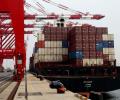
On the back of rising crude oil purchases, India's bill for imports from sanctions-hit Russia jumped 3.5 times in a year in April to $2.3 billion, showed data from the commerce ministry. In April, India's crude oil imports from Russia were valued at $1.3 billion, 57 per cent of India's total inbound shipments from Russia. Other major imported items during the month included coal, soybean and sunflower oil, fertilisers, and non-industrial diamonds. That month, Russia was also the fourth-largest crude petroleum supplier to India, after Iraq, Saudi Arabia, and the United Arab Emirates (UAE).

Some of these nations are India's biggest export market. India is also dependent on these countries to meet its energy needs.

In a bid to protect the domestic paper industry, the commerce and industry ministry on Thursday said it has decided to make registration compulsory for importing major paper products such as newsprint, handmade paper, envelopes, among others. All imports arriving on or after October 1 will be governed by the Paper Import Monitoring policy that aims to put an end to dumping of such products and address the issue of re-routing of goods through other countries in lieu of trade agreements. "The import policy of major paper products has been amended from 'Free' to 'Free subject to compulsory registration under Paper Import Monitoring System," an official statement said.

Shipments from Russia rose nearly 33 per cent to $1.1 billion in March from $831.17 million in the previous month, which was when the country mounted aggression on Ukraine and faced sanctions from Western nations, the data accessed by Business Standard shows. Growth in imports was largely on account of oil, people aware of the matter said. The Department of Commerce is learnt to have written to the Ministry of Petroleum and Natural Gas (MoPNG), seeking details of imports, including the payment mechanism, which India has not made public.

This will be done across five cities - Delhi, Bengaluru, Coimbatore, Bhopal, and Shillong. Thereafter, it will be scaled up and launched in 100 cities over a period of six months, said a senior government official.

Nepal's decision to ban the import of non-essential items amid depleting forex reserves may hit Indian exports. The country's central bank - Nepal Rastra Bank - last week instructed commercial banks not to open letters of credit (LCs) for importing non-essential items. This is to prevent further decline of the country's foreign exchange reserves. However, it has not issued any formal communication yet.

The Centre is unlikely to announce an agreement over payment mechanism with Russia until a ceasefire is declared in the Ukraine war, said people in the know. An inter-ministerial group headed by the finance ministry has been meeting regularly for over a month to analyse and discuss payment mechanisms that can work under the current circumstances and ensure the trade between India and Russia is not disrupted. The US had recently said that there would be consequences for countries actively attempting to "circumvent or backfill" American sanctions against Russia.
Economic recovery from the pandemic in the US has helped India achieve the $400-billion mark for exports for the first time in any fiscal year. According to the preliminary data compiled by the Department of Commerce, India exported goods worth $73 billion to the US from April 1 to March 21 - up 47 per cent, compared to last year. The US' share of exports, compared to total exports, stood at 18.2 per cent. The country is also India's largest trading partner and export destination.

Exporters are readying back-up routes to send their shipments to the nations belonging to the Commonwealth of Independent States (CIS), including Russia, as the war in Ukraine continues to intensify. Three routes are being explored. The first is the China route using Qingdao port. The second is the International North-South Transport Corridor (INSTC) route that connects Mumbai to Moscow via Iran and Azerbaijan.

India is looking to develop alternative export markets for tea such as Iraq, Saudi Arabia, the US, Japan and Tunisia in view of the Russian invasion of Ukraine, people aware of the matter said. Meetings are being held with buyers in some of these countries in virtual mode, with the help of diplomatic missions located there. Similar meetings for the remaining countries have also been planned.

India's exports are unlikely to get an immediate boost from a depreciating rupee, which touched an all-time low on Monday, driven by rising commodity prices. The rupee fell to 76.97 against the dollar earlier in the day, settling 1.05 per cent weaker than the previous close. Oil prices soared to their highest since 2008 on Monday at $139 per barrel, after the US and European allies explored a Russian oil import ban, while delays in the potential return of Iranian crude oil to global markets increased supply fears.
 © 2026 Rediff.com - Advertise with us - Disclaimer - Privacy Policy - Sitemap - Feedback - About us - Terms of use - Grievances